
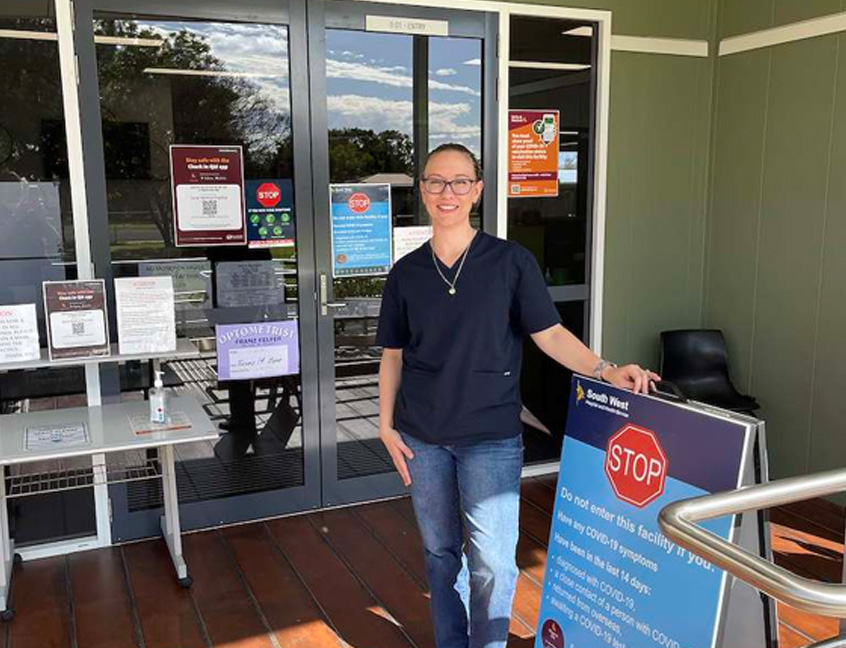
In rural medicine, conversations about workforce often focus on recruitment, retention and vacancy rates. But perhaps the more interesting question is not why doctors leave, but why they stay. For Dr Talia Trigger, the answer is not a single thing. It's family, community, continuity of care, professional fulfilment and learning how to make a demanding career sustainable over the long term.
Talia arrived in Surat, a small Southwest Queensland community, with no grand plan to stay. After completing Emergency Medicine advanced skills training, she was looking for her next role when an opportunity arose. ’I went home, had a chat to my husband and we thought we'd give it a crack,’ she recalls. More than 8 years later, she's still there.
Today, Talia works across Surat's Multipurpose Health Service, delivering care in general practice, emergency medicine, inpatient services and aged care. She works a two-weeks-on, two-weeks-off model, with her working fortnight involving 24/7 on-call responsibilities. It's a model familiar to many, bringing both professional variety and significant demands. ‘It's not the calls all the time. It's that general fatigue of being on-call and not being able to leave town. Anyone who's done it understands that it's tiring in itself.’ Some fortnights are relatively quiet. Others involve full clinic days, inpatient responsibilities and overnight call-outs.
Sustainability isn't optional
Shortly after achieving Fellowship, Talia welcomed her first child while navigating her own health challenges. ‘It was just this snowball effect and it got on top of me. I just went, “I can't”.’ Recovery involved time away from work, psychological support and a reassessment of how she approached both medicine and life. The most important lesson? Boundaries. ‘I'm a people pleaser,’ she says. ‘Instead of just going, “it's one more thing” or “I'll just help this person”, I've had to put firm boundaries in.’ Those boundaries are practical rather than dramatic.
Protecting a lunch break. Limiting overbooking. Avoiding corridor consultations. Ensuring script requests receive the same respect for time as any other clinical task. ‘It's not just a script. It takes time. Putting it into my day instead of letting it sit on top of my day has made a big difference.’ But sustainability extends well beyond the consulting room. ‘It's completely predictable and everyone says it, but it's still true. You need to have a life outside of medicine that makes you happy and passionate too.’ For Talia, that means studying horticulture, growing flowers and reading novels. ‘They're things that are completely just for me.’ In a profession where work can easily occupy every available space, maintaining interests unrelated to medicine has become an important part of preserving both wellbeing and longevity.
You're alone, but you're not really alone
One of the most persistent assumptions about solo practice is that it is professionally isolating. Talia acknowledges the responsibility of being the only doctor on site but challenges the idea that solo practitioners work in isolation. ‘People say, “but you're alone” And yeah, I am, but you're not actually alone.’ Within the health service, experienced nurses, practice staff and administrative teams provide both practical support and opportunities for informal debriefing. ‘We're a really close-knit health service.’ Beyond the community, Talia has intentionally built a network of trusted supports, including an emergency physician colleague and a psychologist she has worked with for several years. ‘I'll shout from the rooftops about having a psychologist. I think everyone needs one in their life.’
For solo practitioners in particular, having a consistent, confidential support person can provide a valuable anchor during difficult periods. Family support has also been critical. Talia and her husband have 3 children, including twin daughters. Over time they have developed a rhythm that allows family life and rural practice to coexist sustainably. ‘When I'm working, he's the primary caregiver. He does everything in the house. Then when I'm off, we switch.’
The reward of continuity
When asked what keeps her in Surat, Talia's answer is immediate. ‘It's home.’ Over the years, Surat has become far more than a workplace. It is where she and her husband have raised their children, built friendships and become embedded within the community. That connection shapes the way she practises medicine. As she provides care across general practice, hospital and aged care settings, she often knows patients' stories long before they arrive at the hospital door. ‘They don't have to rehash their whole story. I know it.’ The continuity of care frequently described as a hallmark of rural generalism is something she experiences every day. ‘It's that cradle-to-grave thing that we talk about. When you actually experience it, it's something really special.’ For Talia, continuity is more than a healthcare concept. It's the opportunity to walk alongside patients and families over time, developing relationships that extend beyond individual presentations or episodes of care.
Comfortable with being uncomfortable
For rural generalists considering solo practice, Talia believes clinical capability is only part of the equation. ‘You need to be really comfortable with being uncomfortable.’ The uncertainty inherent in our work is amplified when you're the only doctor on site. You've got to be confident making that assessment of “yes, this can wait” and “no, it can't”, and being comfortable with that.’ Equally important are support systems, professional relationships and realistic expectations. ‘You can't be there for everyone all the time and that's okay.’ While solo practice is not for everyone, Talia believes it remains an important part of Australia's rural healthcare landscape.
Despite the challenges, she has no plans to leave. ‘It's a hard job,’ she says, ‘but the community, the relationships and the continuity supersede the hard stuff.’ In an increasingly fragmented healthcare system, her reflections offer a reminder of what continues to draw many of us to the bush and keep us there: meaningful relationships, shared community and the privilege of caring for people across every stage of life. Or, as Talia puts it simply: ‘It's home.’