
The John Flynn Prevocational Doctor Program (JFPDP) is now known as the Australian Primary Care Prevocational Program – Rural (APCPP – Rural).
I really enjoyed my time on Palm Island. The Joyce Palmer Health Service (JPHS) is a fantastic service, and the community is welcoming. I particularly valued working alongside Aboriginal and Torres Strait Islander doctors and health workers, who make up most of the ongoing staff, and have a deep understanding of the community and each patient’s biopsychosocial context.
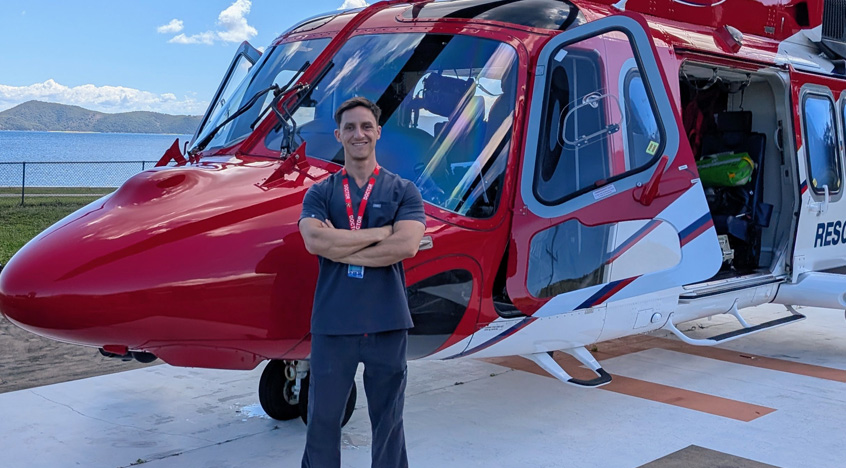
I also had the benefit of working with nursing, midwifery, Retrieval Services Queensland (RSQ), Townsville University Hospital, renal, mental health, pharmacy, administration, security, transport, and kitchen staff. Each person taught me something valuable from their professional background.
My connection to Palm Island
I first went to Palm Island in 2019 with one of my best mates from university who grew up there and was also studying medicine at JCU. I visited him in early 2025 when he was doing placement on the island. He introduced me to local family, showed me around and was a huge influence on why I wanted to work on Palm Island.
Building on previous experiences
My experience on Palm Island complemented my past placements in remote communities, such as Kalkarindji, Thursday Island, Weipa, Alice Springs, Solomon Islands and Fiji. Each community and health service is unique, but common challenges include limited staffing and resources. For example, while some staff here can perform x-rays within a limited scope of practice, there is no sonographer, CT or MRI scanner, or pathology lab on the island.
That said, Palm Island is relatively well resourced, with both a hospital and a Primary Health Centre with GPs, nurses and visiting allied health providing care for around 2,000–4,000 people. Government funding supports patient transfers by commercial plane or ferry to Townsville for further investigations or specialist appointments, and RSQ facilitates urgent transfers for critical patients.
Inspired by values: a commitment to health equity
My parents taught Aboriginal and Torres Strait Islander studies and history as high school teachers. My Auntie and cousins are Noongar people and have spent much of their lives working with other Aboriginal and Torres Strait Islanders. But much more than family ties, I am inspired by the values I was raised with, particularly a respect and interest in other cultures and a strong value for social justice. Initially, I considered a career in foreign aid and development, but I came to realise the need to address the health gap between Indigenous and non-Indigenous Australians. I now aim to build a career focused on contributing to health equity in Australia however I can, with Aboriginal and Torres Strait Islander doctors, nurses and other workers leading the way.
On Palm Island, the legacy of colonialism and institutional racism is still very present. Some locals described to me how the island was established to remove so-called ‘troublemakers’ from Aboriginal missions across Queensland, essentially functioning as a geographical prison. The community, known as Bwgcolman (‘many people’ or ‘many tribes’), comprises around 50 different tribal groups who were forcibly relocated here.
I’ve met community members in their 60s and 70s who recall growing up under these policies—when Aboriginal and Torres Strait Islander people were forbidden from entering certain parts of town, needed permission to leave the island, to fish, or were subject to curfews. Non-Indigenous residents had electricity and running water, while Indigenous families did not. These were not distant injustices, they shaped the lives of today’s parents and grandparents and continue to affect the community. In the hospital, we see these lasting impacts every day as the social determinants of health.
Support during rotations
I was fortunate to be supported by many local health professionals during my rotation. My main supervisor was Dr Rob Blackley, well known on Palm Island as Australia’s youngest mayor and now a senior doctor. He has been an excellent mentor, teaching me practical skills and offering deep insight into working with Aboriginal and Torres Strait Islander patients. Dr Rob explained the cultural contexts of Palm Island and the families presenting to the hospital. JPHS’s Aboriginal Health Worker, Malita, and Aboriginal Liaison Officer, Maisey, also provided valuable teaching and deeper insights into the community.
I also worked with many of the regular doctors at JPHS during my 10 week rotation, as well as a range of locums, each bringing experience from other rural and remote communities. The nursing staff and broader team all taught me invaluable lessons throughout my term.
Advice for a rewarding experience
Be friendly, culturally safe, authentic and interested in patients and the broader community. Get involved in local sport, events, festivals and actively engage with people outside the hospital. Remember that patients are much more than their presenting complaint, medications, investigations and treatment plan. They are people first with families, jobs, hobbies and lives outside the hospital.
Make the most of any education available – JPHS was very generous, offering training and workshops directly linked to ACRRM logbook items. I also completed neonatal resus while there.
Palm Island is incredibly beautiful, with long coconut-lined beaches, eucalyptus forests, wetlands, and rainforests with waterfalls. On days off, I enjoyed hiking, swimming, fishing, and exploring. Highlights included seeing whales most days, fishing and swimming with Dr Rob and his family on his boat around nearby islands, and experiencing the traditional dancing, singing, and festivities of NAIDOC Week.
Why you should consider a JFPDP rotation
This opportunity has made me more confident in clinical decision-making with less supervision and given me valuable insight into the diverse roles rural generalists perform in rural and remote practice. It has also given me a clear insight into working in a remote Aboriginal and Torres Strait Islander community from the ward and in ED, to the AMS.
If it’s something you’re considering – have a crack, rather than wondering ‘what if’.