
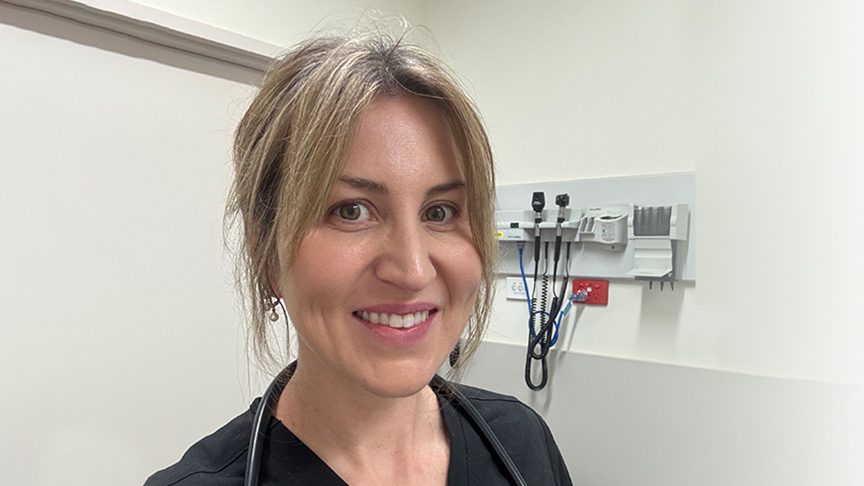
I am a rural generalist with an advanced skill in anaesthetics who lives and works in Mount Isa.
When I began my registrar years in northwest Queensland, I knew rural practice would be challenging. What I didn’t fully appreciate was just how profoundly rewarding and transformative it would be - both professionally and personally.
Rural generalists work across vast areas with diverse communities - from Mount Isa to Doomadgee, Mornington Island to Cloncurry, Burketown and beyond. I learned just how remote northwest Queensland really was when I ventured out in January 2021 in my Mazda 3 from Brisbane with my Lovebird Lola Zizi in the front seat and the air conditioning on high. What an adventure!
Currently, along with my role as Director of Rural Generalist Training for North West Hospital and Health Service, I work across the Royal Flying Doctor Service (RFDS) primary care, ED, anaesthetics, remote site coverage and aged care - often in the same day.
In this context, one of our greatest strengths in rural medicine is continuity. Continuity of care, yes, but also of relationships. Where I work, leadership is not about titles. It is about those relationships, determination and action. In many ways, it is about stepping into the gaps that can be common in rural and remote practice.
In the transition from registrar to consultant, I’ve shifted from being a learner under supervision to a leader of teams. This shift can feel daunting, but it’s a continuation of what we’ve been doing all along - listening, learning, advocating - now with a little more experience and a lot more responsibility.
I have seen a lot of change in my short 5 years in Mount Isa – a constant reality in rural medicine. Our community is evolving and models of care are adapting. There is a refocus on growing our own, not just individual doctors, but the entire ecosystem of care. I’ve been able to use my experiences and local community knowledge to support the ‘grow your own’ approach. I am privileged to aid in designing creative roles that I would’ve loved while training. By understanding the skills required in different settings, we can match trainees based on their goals and training needs, while also trying to meet community expectations and needs.
It’s rewarding to see the enthusiasm of our future rural generalists. I’m hopeful people will stay in the region with more opportunities to work to the full scope of a rural generalist and more flexible working arrangements creating long term sustainability for our workforce. At the end of the day, I want to see people enjoy their work, invested in their community and working in a way that is sustainable for years to come!
One of the great joys of rural generalism is the opportunities that come from both living and working in the community. By being involved in your community, you gain a better understanding of your patients and their lives. You also build your networks and help protect yourself from the fatigue associated with FIFO work.
I’ve found my community experience and life journey to be just as important as my professional growth. My husband and I are now proud members of the Mount Isa Golf Club, and I have taken on pitching for the local softball team (albeit not well!). We love hosting sunset picnics at Lake Moondara and truly feel like part of the community. I’m now married, a proud Toyota owner (equipped with all-terrain tyres!), and mother to our fur baby, Artemis Isa Moose - yes, named after Mount Isa!
So, what have I learned about leadership beyond coordinating camping trips to the Gregory?
- Listening is as important as doing.
- Living and playing in the community in which we work gives us unprecedented access to understanding and serving it.
- Leaning into those gaps will be challenging but it is an opportunity for growth.
Rural generalism is where adventure meets opportunity and so for those just starting their career I’d say lean into those gaps. Whether it’s a leadership role or pitching for the local softball team, take the opportunities, learn and grow with your community.