
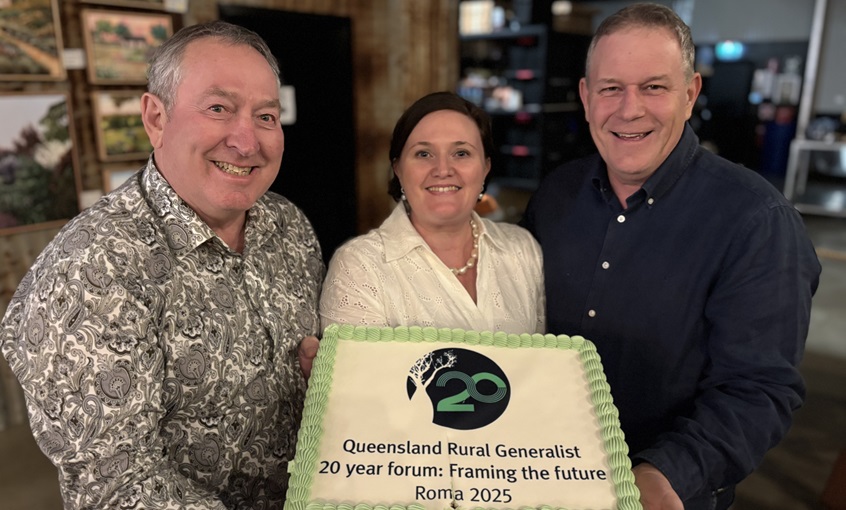
Rural doctors and leaders converged in Roma on 2 and 3 October for the Queensland rural generalist 20 year forum.
Hosted by the Queensland Rural Generalist Pathway (QRGP), the forum celebrated 20 years of rural generalism in Queensland and explored what needs to happen next.
Over 180 delegates attended from across Australia, including Queensland and federal health executives, key stakeholders, community members, rural health leaders, interstate health agencies, rural generalists, general practitioners and medical students.
Attendees celebrated the milestone of national recognition of Rural Generalist Medicine, reflected on how far rural medicine has come and collaborated to frame the future.
Key discussions were held on improving access to care in rural and remote communities and how rural generalists are attracted, trained, supported and retained.
Dr Prue Wallin, QRGP’s Medical Director and one of the Pathway’s early trainees, reflected on the changes in the medical landscape over the last 20 years.
'We’ve seen a revolution in rural medicine since the Roma agreement in 2005. There were 37 doctors training with the QRGP in 2007. There are now nearly 400 trainees, and more than 330 trainees and graduates working in our rural and remote communities,' Dr Wallin said.
'We’ve seen what happens when rural communities have access to skilled, connected, compassionate care.'
'With the recent announcement of national recognition of Rural Generalist Medicine as a specialist field in general practice, it’s more important than ever that we get our training, recruitment and retention right to ensure we are strengthening rural generalist care where it’s needed most,' she said.
Annabelle Brayley, Chair of Remote Australian Matters, was a guest speaker on the community panel at the forum and said it was fantastic the forum had the wellbeing of rural and remote communities at the centre of its thinking.
'There's been a real effort at this forum to engage community members and to bring regular grassroots perspectives into the discussion’, Ms Brayley said.
'I applaud the Queensland Rural Generalist Pathway for embracing the idea of connecting and working with the community over the design of their healthcare.'
'I think that will translate to good outcomes.'
Delegates came together to set key priorities for the future of rural generalism including strengthening support for First Nations trainees, developing new ways to attract and retain doctors in the bush, and boosting the economic viability of care in rural Queensland.
Nine key points were agreed to at the forum with further work to be done to refine the 2025 Roma Rural Generalist Charter, which will guide the profession over the coming decade.
Australian College of Rural and Remote Medicine President Dr Rod Martin said rural generalism was at an important stage of evolution and collaboration would be key to the profession’s future success.
'We need to make sure the metropolitan parts of Queensland and Australia are clear about what we want to achieve and help us properly deliver rural generalist medicine to the communities that need us,' Dr Martin said.
QRGP Medical Director Dr Prue Wallin said she hoped the charter would also be a guiding document for other states across Australia still working to develop rural generalists.
'We are proud of what we’ve achieved over the past 20 years, and it’s been due to the hard work and contributions of so many people,' Dr Wallin said.
'The QRGP is looking forward to continuing to improve access to healthcare in our communities over the coming decade, using the Roma 2025 charter as our guiding light.'