
Education level
Job area
Your role as a nuclear medicine scientist
As a nuclear medicine scientist, you'll manage radioactive materials for imaging and therapies. It's your role to:
- prepare the radioactive materials (radionuclides and radiopharmaceuticals) for imaging and treatment
- take images to help detect, diagnose and assess the treatment of disease
- explain the procedure to your patient and answer any questions.
Depending on where you work you might sometimes need to be on call.
What your day might look like
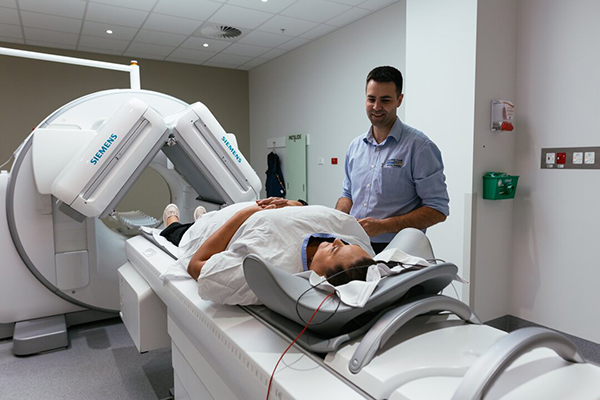
You'll take images of how the body is working using equipment like positron emission tomography (PET) and single photon emission computed tomography (SPECT). These scans help doctors find, track and monitor conditions such as cancer, heart disease, and brain disorders.
You'll need to make sure radioactive materials are prepared safely and given to patients in the correct amount.
Your role will also involve a lot of patient care. You'll make sure patients are safe and comfortable and are in the right position for each procedure. They may have questions or feel anxious. It's your role to support, provide accurate information and reassure them throughout their visit.
Learn more about working as a nuclear medicine scientist on Your Career.
Qualifications
Bachelor's degree in nuclear medicine.
Get hands on experience and mentoring while you study for your degree by joining our nuclear medicine scientist embedded student program.
You might also be able to get financial support while you're on our student program. Find out about our nuclear medicine scientist scholarships.
Professional registration
Registration with the Medical Radiation Practice Board of Australia
Pay and benefits
Your pay rate and benefits will depend on your role and your pay point. In your first year you’ll start at health professional grade HP3, pay point 1. You’ll get a different rate if you’re in a higher level role.
We also offer:
- a nuclear medicine technology development allowance
- regular wage increases
- a superannuation rate of 12.75%
- a supportive workplace with flexible working arrangements
- several types of leave
- extra annual leave days for some roles
- salary packaging
- help with ongoing professional development costs.
If you're moving to start a new job with us, you may be able to get help with moving and travel costs.
Rural and remote opportunities
You may also be able to get financial incentives and other benefits if you work in rural and remote areas.
Read about our opportunities for rural allied health careers.
Professional growth
Continuing professional development (CPD) is an essential part of being a nuclear medicine scientist. You'll have opportunities to build CPD points through things like:
- rural experience
- research
- access to education and training with the Clinical Skills Development Service and the Cunningham Centre.
Career paths
Doing more training or qualifications after you become a nuclear medicine scientist can lead to other roles.
- Diagnostic radiographer
- Sonographer
- Digital imaging systems management
- Clinical educator
- Research
If you plan to do more study, ask your training provider if your past studies can count towards a higher qualification.