
Education level
Job area
Your role as a maintenance fitter
As a maintenance fitter, you’ll make sure that the systems that keep our hospital running are reliable and working well.
This includes:
- inspecting and maintaining pipes, machinery, equipment and hospital infrastructure
- finding and fixing faults and other problems
- following safety laws and standards.
We have full time, part time and casual roles, and you may work shifts or be on call.
What your day might look like
Most maintenance fitters work in our hospitals and health centres, but you might also travel to:
- aged care homes
- central office buildings
- pathology labs and mortuaries
- research and storage facilities
- automated industrial laundries.
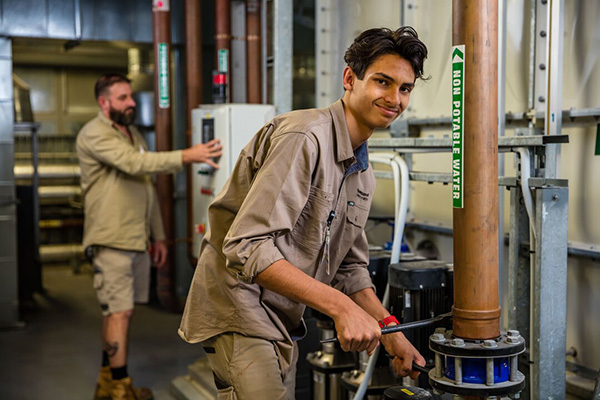
You’ll start the day by checking in with your team and responding to any urgent issues or system failures.
You’ll inspect and maintain a range of systems, including:
- heating, cooling, refrigeration and ventilation
- water, gas and hydraulics
- boilers, steam lines and sterilisation machines
- mechanical plant and machinery
- laboratory fume extraction systems
- fire and safety systems.
Many of these systems support patient care and must be in good condition to prevent failures. This might include testing, adjusting, repairing or replacing:
- bearings, belts, valves, seals
- motors, pumps, actuators and compressors
- pipes and worn or damaged parts.
You’ll also be cleaning, servicing and oiling moving parts in our equipment and machinery.
A big part of your job is keeping people safe. You’ll follow workplace procedures and safety standards and keep records about the work you do. You’ll also work in a way that helps prevent the spread of germs and infection.
If you’re part of a bigger project, such as a system upgrade, you’ll also work with tradespersons, contractors and health professionals.
Read more about working as a maintenance fitter on the Your Career website.
Qualifications
Mechanical trade apprenticeship (Certificate III in Engineering – Mechanical Trade)
Professional licences
You must have a Queensland driver licence (C class) if you need to drive as part of your job.
You might need a licence or extra training to do certain types of work, such as:
- construction or demolition
- putting up or taking down scaffolding
- using a forklift, crane or hoist
- working on lifts, escalators or pressure equipment
- driving large machinery on the road.
Learn more about workplace licences on the WorkSafe website.
Pay and benefits
Your pay rate and benefits will depend on your role and your pay point. In your first year you’ll start at health, building, engineering and maintenance officer grade 6, pay point 1.
We also offer:
- regular wage increases
- a superannuation rate of 12.75%
- a supportive workplace with flexible working arrangements
- several types of leave
- salary packaging
- allowances and help with training costs.
If you're moving to start a new job with us, you may be able to get help with moving and travel costs.
Career paths
Getting experience as a maintenance fitter or doing more study can lead to other roles.
- Mechanical trade manager
- Engineering manager
- Building and maintenance manager
If you plan to do more study, ask your training provider if your past studies can count towards a higher qualification.