
Education level
Job area
Your role as a dental specialist
As a dental specialist, you’ll provide expert advice and treatment for people with complex oral conditions.
You’ll be an experienced dentist, with advanced training and skills in one or more of these specialist areas.
- Oral medicine – diagnosing and treating conditions of the mouth jaw and face, such as sores, pain and saliva gland problems
- Oral surgery – removing teeth or doing minor mouth surgery
- Oral and maxillofacial surgery – major surgery of the mouth, jaw, face or neck
- Oral and maxillofacial pathology – checking tissue from the mouth, jaw, face and neck for signs of disease
- Endodontics – treating pain or problems inside teeth
- Orthodontics – straightening teeth and correcting bite problems using braces and aligners
- Periodontics – treating the gums and bones that support teeth and implanting false teeth
- Prosthodontics – replacing missing or damaged teeth with false teeth
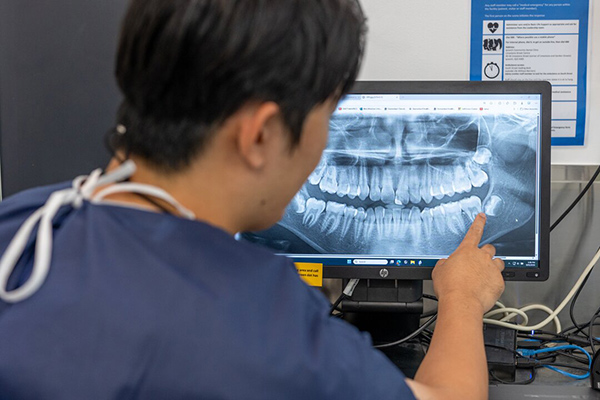
- Dento-maxillofacial radiology – reviewing complex dental x-rays and scans and explaining what they show
- Paediatric dentistry – children’s dental health
- Special needs dentistry – dental health of people with disability or complex needs
- Public health dentistry – using education and prevention to improve the dental health of large communities
- Forensic odontology – using dental records to identify people and learn more about them
We have full time, part time and casual roles.
What your day might look like
If you work in one of our hospitals or clinics, you’ll start the day by checking in with your team and preparing for appointments or surgeries.
You’ll diagnose and treat people with complex mouth, jaw, face, head and neck conditions such as:
- tooth, gum and saliva gland problems
- growths, abscesses and cysts
- misalignment, fractures and trauma
- severe or long term pain or infection.
You may also book them in for operations or procedures such as:
- tooth removal, implants and fitting false teeth
- biopsies and bone grafts
- reconstructive surgery
- corrective treatment such as braces.
In areas like radiology, forensics or public health, you’ll spend a lot of the day working with information, scans and reports. You might work in an office or lab and may not see patients in person.
Read more about working as a dental specialist on the Your Career website.
Qualifications and experience
You need all of the following credentials to be a dental specialist.
- Bachelor’s degree in dental medicine, dental science, dental health science or dental surgery
- 2 years in general dental practice
- Postgraduate qualification in a dental specialty
If you specialise in oral and maxillofacial surgery you also need a medical degree and at least 4 years of specialist surgical training. Fellowships are through the Royal Australasian College of Dental Surgeons and the Royal Australasian College of Surgeons.
If you specialise in forensic odontology, fellowships are through the Royal College of Pathologists of Australasia.
Professional registration and licences
- Registration in your speciality with the Dental Board of Australia
- If your specialty is oral and maxillofacial surgery, you'll need to be registered with both the Dental Board of Australia and the Medical Board of Australia
You also need a Queensland Radiation Use Licence to take x-rays. Read more about licencing in the dental industry.
Pay and benefits
Your pay rate and benefits will depend on your role and your pay point. In your first year you’ll start at dental grade DS1, pay point DS1.1.
We also offer:
- regular wage increases
- a superannuation rate of 12.75%
- a supportive workplace with flexible working arrangements
- several types of leave
- salary packaging
- help with radiation licence and ongoing professional development costs.
If you're moving to start a new job with us, you may be able to get help with moving and travel costs.
Professional growth
We help new graduates get the skills and experience for a long term career in public dentistry through our early career dental practitioner program.
You’ll also develop your professional skills through:
- orientation programs for new staff
- workplace learning and coaching
- self-directed learning
- professional development and upskilling opportunities.